
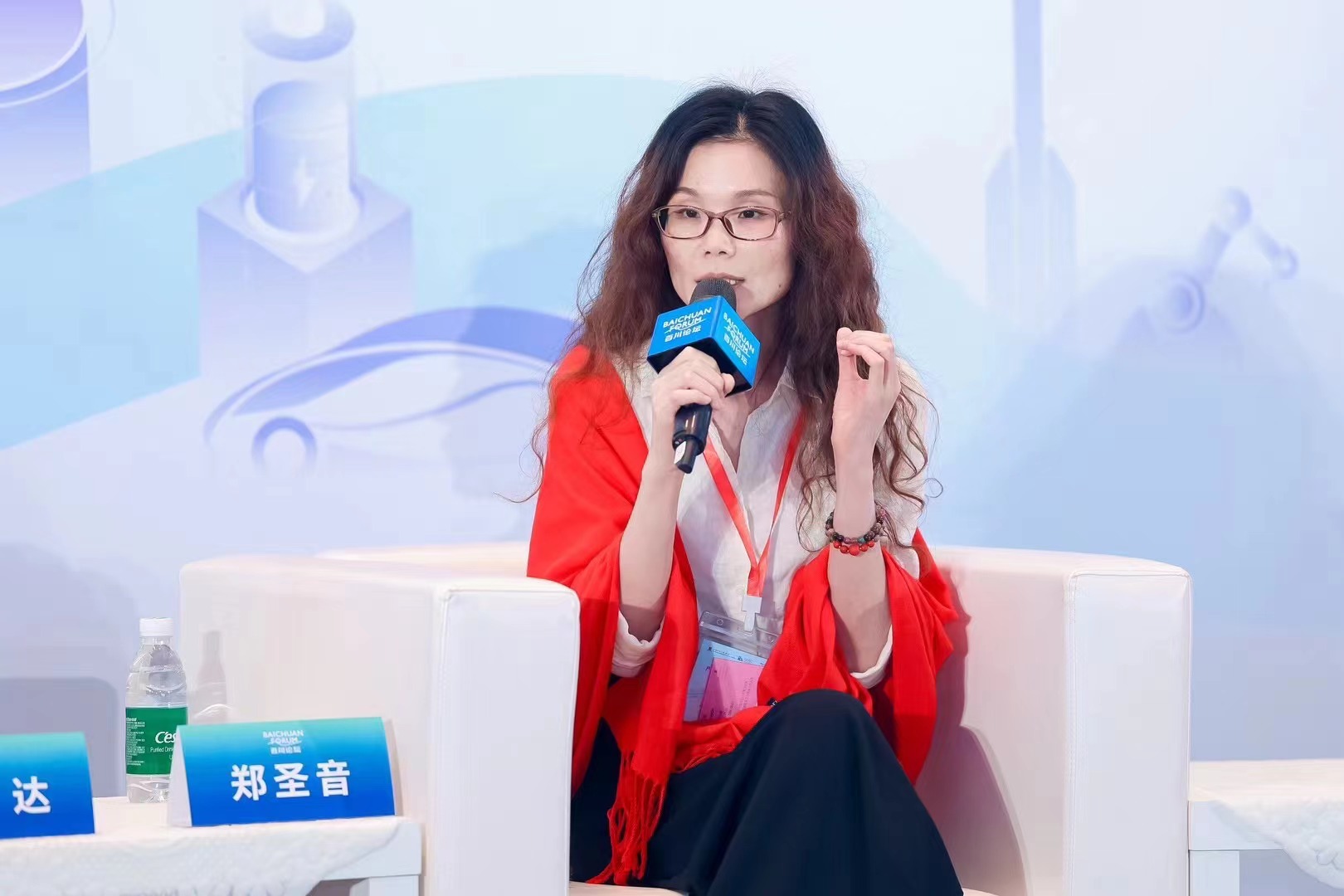
On 24 August, the Baichuan Forum, the Third Symposium on the Theory and Practice of Chinese Political Economy, "Industry and Modernization: China and the World" 2024, hosted by the Institute for International Affairs, Qianhai (IIA) of The Chinese University of Hong Kong, Shenzhen, opened in Qianhai, Shenzhen. Scholars and business experts from North America, Europe, Africa and Asia held a broad and in-depth discussion of Chinese modernization from the perspective of human social development, examining China's practice and the world's experience of modernization at the level of industry. WeCarbon's China Partner Ms. Mia Zheng was invited to attend and speak.
Guided by the idea that "the sea is great because it takes in a hundred rivers," the IIA created the Baichuan Forum as its own academic event brand, aiming to give thinkers in China and abroad a broad and inclusive platform that pools ideas and adds intellectual momentum to China's development in the new era. Since 2021, the institute has held the Baichuan Forum every year, inviting experts and scholars from many fields, senior policy researchers, entrepreneurs and government officials to discuss in depth topics such as the theory and practice of Chinese political economy, the external environment, industrial policy and the Sustainability strategy, providing a theoretical and practical basis for China's strategies and policies.
Zheng Yongnian, President of the Institute for International Affairs, Qianhai and Dean of the School of Public Policy at The Chinese University of Hong Kong, Shenzhen, gave the opening address, sharing his thoughts on China's private enterprises and industrial development. He said that "on the new journey of China's economic development, private enterprises are playing an ever more important role": they are not only major contributors to tax revenue and GDP, but also the main source of technological innovation, jobs and new businesses. He noted that private enterprises now face challenges of a new order, arising not only from changes in the external environment but also from deep internal structural adjustment. How can industry keep developing? Zheng Yongnian called for comprehensive and deeper reform as the way to turn ideas into practice and drive industry forward as a whole.
At the forum, Ms. Zheng spoke on the topic of "Enterprises and Industrial Development" with a talk titled "ESG and the China Narrative". She said: "Against the backdrop of globalization, enterprises play an important role on the path of Chinese modernization. We borrow ESG (environmental, social and governance), the framework that Western capital markets use to assess corporate social responsibility, and use this widely accepted international 'language' to unpack China's development strategy, the requirements and path of 'Chinese modernization', and 'the guiding principles and requirements of the 20th CPC National Congress', and we find that they arrive at the same destination by different routes. This leads us to our view: using the ESG framework and way of thinking to present the 'China model' and tell the 'China story' well can, in these unpredictable times, build a bridge of communication between China and the world and foster understanding and cooperation."
As an early advocate of ESG, WeCarbon has been committed since its founding to promoting business for good and sustainability across society, using technology innovation to drive practice and value creation in ESG and sustainability, and its work has been well received in markets in China and abroad. As more and more Chinese companies pay attention to ESG, many strong companies are putting ESG principles and strategies into practice through reforms of their corporate governance. Along this path, WeCarbon remains focused on how companies build and develop their ESG systems, and is ready to act as a think tank for business, helping sustainability take root across industries and helping companies build the "China model" and tell the "China story" well.