
Author's note
The "ecosystem" has been a business-strategy buzzword for years, yet few have examined its deeper value from an ESG perspective. An ecosystem is a natural system in which living things and their environment are closely linked through the exchange of matter, the flow of energy and the transfer of information, forming an inseparable whole. It occupies a certain space, has a certain structure, performs specific functions and is usually in a state of dynamic balance. In short, its essence is "a network of interdependence among different participants", which fits neatly with the shared-value outlook that ESG champions.
Continuing the distinctive perspective of the "ESG Perspectives" series and using the ESG paradigm as a lens (see the previous article in the series for what we mean by "paradigm"), this article examines how ESG, overseas expansion, data and RWA (Real World Assets) in the digital economy are together driving a far-reaching, ecosystem-level transformation.
Introduction
The volume of ESG data worldwide is surging as sustainability disclosure accelerates; Chinese companies expanding overseas face steadily rising ESG compliance costs; and the RWA market has already passed the USD 30 billion mark [1]. Behind these three seemingly separate trends lie different facets of the same transformation: we are witnessing an ecosystem restructuring built on the ESG paradigm.
The defining feature of this restructuring is that ESG data is no longer just material for writing disclosure reports; it is becoming the link of value that connects overseas expansion, asset digitisation and inclusive finance. As Thomas Kuhn argued in The Structure of Scientific Revolutions, a paradigm shift is at heart a fundamental change in worldview. The ESG paradigm is driving a cognitive revolution from "winner takes all" competition to "shared wins" across an ecosystem.
This article sets out its argument in five parts:
How the data nature of ESG lays the foundation of the ecosystem;
How ESG data becomes the cornerstone of compliance for overseas expansion;
How RWA works as a new model for "taking assets overseas";
How ESG anchors value at the level of RWA's underlying assets;
The social value of RWA seen through the lens of inclusive finance.
Note that in this article, RWA refers to real-world asset tokenisation, i.e. the process of turning physical assets into digital tokens using blockchain technology. This innovation is reshaping the boundaries of asset liquidity and inclusive finance.
1. The ESG data mirror: from isolated indicators to network value
01 The network effects of ESG data
Traditional ESG reports tend to be limited to a company's own disclosures, but from an ecosystem perspective, a single company's ESG data ripples through its supply chain. Take the automotive industry: when a carmaker asks its battery suppliers for carbon footprint data, the request can be passed tier by tier all the way upstream to lithium miners, creating data collaboration across the entire industry chain.
This collaboration reflects the essence of Metcalfe's law: the value of a network is proportional to the square of the number of its participants. As more companies join an ESG data-sharing network, the value of each participant's data grows exponentially. China's power battery industry is fertile ground for such a "shared network". Major players such as CATL and BYD have already begun building carbon footprint and material traceability systems in-house. At the same time, the Ministry of Industry and Information Technology is accelerating the development of a carbon footprint management system for vehicles and power batteries, including unified accounting standards and pilot applications. Building on this, extending the data to cover ESG information such as raw-material traceability, labour protection and resource use, and pooling it in an industry database, would not only help companies meet international requirements such as the EU Batteries Regulation efficiently, but also significantly cut each company's disclosure and certification costs and lift the green competitiveness of the industry as a whole[2].
02 The infrastructure challenge of data governance
Yet beyond the data foundations that still need to be built out, data silos are a pressing problem. The author's research shows that large companies with multinational operations, in solar and wind power for example, must deal with several different ESG standards at once, from GRI, SASB and ISSB internationally to China's CASS-ESG standard, which weakens the comparability and interoperability of data. On the other hand, this fragmentation is also spurring new solutions. For example, the Monetary Authority of Singapore (MAS), through Project Greenprint, has launched pilots of four national digital platforms for green finance aimed at efficient, trusted data flows.
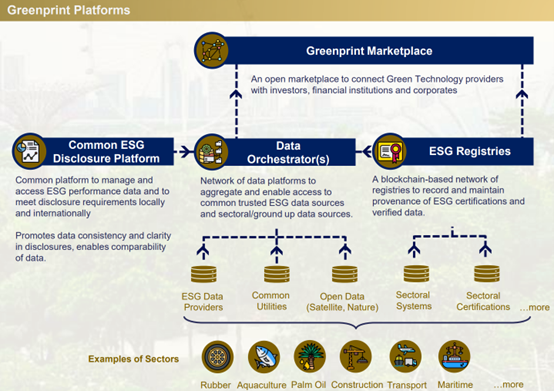
Figure: Introduction to the Greenprint platforms
ESG data is changing from a "compliance burden" into an "ecosystem asset". This recalls the textile machinery innovations of the early Industrial Revolution: just as Hargreaves multiplied efficiency through a simple structural change[3], today's companies are achieving a leap in value by rebuilding their data architecture.
2. Companies going global: ESG from compliance barrier to competitive advantage
01 An ecological reading of the global regulatory map
In 2025, the EU's CSRD entered full implementation, requiring companies to take responsibility for their ESG impacts across the "entire value chain". This means a Chinese apparel company exporting to the EU must disclose not only its own carbon emissions but also track water use in the cotton fields and even the energy consumption of its contract factories in Vietnam. Demanding as this seems, it is in fact pushing Chinese companies to build data alliances that span jurisdictions.
It is easy to imagine a future in which textile industries in several Chinese regions leverage cluster effects, with dozens of exporters forming an ESG data alliance to jointly procure third-party certification services and share, and so reduce, compliance costs.
02 From passive compliance to proactive value creation
Notably, forward-looking companies are starting to turn ESG data into a competitive advantage. Companies selling into the EU, for example, find it easier to win over European customers with complete product life-cycle carbon footprints. Even more innovative practices are emerging in finance. Banks, for example, now offer "ESG-linked data asset pledge loans" and "carbon emission allowance pledge loans", through which companies can use verified ESG data to obtain preferential credit lines.
This brings to mind the railway building of the Second Industrial Revolution: just as the transcontinental railroad reshaped America's economic geography, ESG data networks are reshaping the pattern of global trade. Commendably, unlike the closed mindset of the Chinese Exclusion Act era in the United States (and quite unlike today's MEGA of the Trump 2.0 era), China's data ecosystem building today is more open and inclusive.
3. A value amplifier: RWA's technical framework and ecosystem effects
01 Innovation in the RWA technology stack
RWA's core breakthrough is turning real-world assets into programmable digital assets. Take a renewable energy power station: traditional asset securitisation requires a complex legal structure, whereas on an RWA platform the station's future income rights can be converted into standard tokens, and the minimum investment unit can shrink from "the whole power station" to "a single solar panel".
The technical architecture has three key layers:
Asset layer: IoT sensors collect power generation and equipment operating data in real time
Data layer: blockchain records ensure ESG data cannot be tampered with
Token layer: smart contracts distribute income automatically
Within this framework, ESG data becomes central to valuation. For a solar project, for instance, the price of its RWA token depends not only on generation income but can also be linked to carbon emission reduction data, creating a "green premium".
02 The virtuous circle of network effects
The ecosystem value of an RWA platform rises as participants join. Overseas markets have undoubtedly led the way: some early platforms initially supported tokenisation of a single asset type, but as more asset types (such as renewable energy stations and green buildings) were added, their liquidity pools deepened and the valuation of every listed asset benefited.
These network effects are even more valuable in cross-border settings. Hong Kong's Project Ensemble sandbox allows mainland solar companies to connect directly with the EU carbon market through RWA platforms, solving the settlement difficulties of traditional cross-border transactions. In December 2024, for example, GCL Energy Technology and Ant Digital Technologies completed a photovoltaic physical-asset RWA deal in China raising more than RMB 200 million, with 82 MW of residential distributed solar plants in Hubei and Hunan provinces as the underlying assets, efficiently connecting domestic green assets with overseas capital. This recalls the open spirit of the Fourth Industrial Revolution: just as DeepSeek has built an ecosystem through open source, RWA platforms are connecting global green capital through interoperability standards.
4. Enhanced RWA: from environmental rights to social innovation
01 Turning environmental rights into assets in practice
The tokenisation of environmental rights is diversifying. Beyond the familiar carbon credits (such as CCER, VCS, CDM and GS), new cases keep emerging:
Water RWA: water use rights or quotas are tokenised on a blockchain so they can be traded and transferred on-chain as digital assets[3]
Biodiversity RWA: nature reserves link the results of endangered-species protection to biodiversity finance products (such as loans), tokenise these innovative products as underlying assets, and use infrared camera monitoring data to drive valuation[4]
What these cases have in common is that ESG data is not only disclosed but takes a direct part in value creation. Just as the Third Industrial Revolution turned information into productive capacity, today's innovation is turning ecological value into economic value.
02 A breakthrough in financialising social assets
Even more encouraging is the exploration of social innovation assets. A small-commodities market has launched an "ESG credit token" that turns merchants' records of honest business (such as return rates and customer reviews) into financing credentials. Projects like this can rely on blockchain records to ensure the data is authentic, reliable and traceable.
Another typical case is "rural revitalisation RWA": tokenising the income rights of agricultural products to attract urban capital into rural revitalisation [5]. Particularly noteworthy is the use of technology to measure social impact, with satellite remote-sensing data used to assess a project's effect on local employment and incomes.These practices bear out the view of DeepSeek's founder: "Innovation needs curiosity and the desire to create, not just commercial drive." When financial innovation is combined with the creation of social value, more resilient ecosystems emerge.
5. The rise of inclusive finance: from technological enablement to governance innovation
01 Building a multi-tiered inclusive finance system
In the author's view, RWA can transform inclusive finance at three levels:
International level: encourage qualified international organisations and institutions to buy high-quality ESG-enhanced RWA, providing low-cost funding for green projects in developing countries
National level: financial institutions can package ESG loans to micro and small enterprises as RWA, giving assets that traditionally could not reach capital markets access to financing
Individual level: fractional investment interfaces let individual investors put a few thousand yuan into solar power stations that would otherwise require tens of millions
This multi-tiered system is changing how inclusive finance is achieved. Unlike traditional inclusive finance, which relies on policy subsidies, RWA can discover value through market mechanisms and bring marginalised groups genuinely into the mainstream economy.
02 Social innovation in governance
The deepest change may come in governance. DAOs (decentralised autonomous organisations) are starting to be used to manage RWA: the investor community of a rural solar power station can vote to put part of its income towards improving local education facilities, with a smart contract executing the decision automatically. This model can make the "S" (social dimension) of ESG real. It recalls the Doomsday Clock set up by the Bulletin of the Atomic Scientists (which the author has written about before): only when technological development is combined with inclusive goals can we move the hands away from midnight.
As Oppenheimer said after the successful atomic bomb test: "Now I am become Death, the destroyer of worlds." Today's innovators need the guidance of technology ethics all the more, to ensure the fruits of innovation benefit a wider population.
Conclusion: the future path of paradigm restructuring
Looking back over four industrial revolutions, from the Spinning Jenny to DeepSeek, every technological leap has been accompanied by profound social restructuring. What sets today's ESG-based ecosystem restructuring apart is that it embeds environmental responsibility, social inclusion and transparent governance into the entire process of value creation.
The Trump administration's protectionism 2.0 (see the previous article in this series) resembles the Chinese Exclusion Act of the Second Industrial Revolution era, seeking security through closure. But history shows that real resilience comes from open collaboration. Although ancient China's textile machines did not spark an industrial revolution, their innovative core has travelled through time and found new life in today's RWA and ESG ecosystems.
The future is already here, and change is the one constant. Under the new ESG paradigm, the author hopes to see more companies shift from "chasing small wins" to "long-termism", building open, inclusive ecosystems that achieve genuine sustainable development. For only when innovation and technology ethics are given equal weight can we move together towards a more resilient future.
Notes and references:
[1] Q3 2025 Real World Asset Tokenization Market Report
[2] The story of the British inventor James Hargreaves, who invented the "Spinning Jenny" in 1764, one of the landmark inventions at the start of the Industrial Revolution
[3] BlockApps (2024). The Impact of Tokenized Water Rights on Environmental Sustainability.
[4] NatureFi (2025). Tokenizing Biodiversity Credits for Habitat Preservation.
[5] "Zhongnong Rongxin and Eddid Financial reach comprehensive strategic cooperation to jointly promote agricultural asset RWA and start preparations for a Hong Kong listing", China Daily (chinadaily.com.cn), 2025
About the author
Ms. Mia Zheng:
Partner (China), WeCarbon
Member of the Global Impact Investing Network (GIIN) expert group
Deputy Director, Academic Committee of the Green and Low-Carbon Technology Research Center, SJTU-UNIDO Joint Institute of Inclusive and Sustainable Industrial Development
ESG Expert, CIECC Overseas Consulting Co., Ltd.
ESG Think Tank Expert, China Investment and Development Promotion Association
ESG Affairs Representative, Shanghai Climate Week Executive Committee