

On 30 May 2026, the 14th (2026) Shanghai International Financial Center International Symposium (SIIFC) was held at the Yuehai Hotel Shanghai. Under the theme "High-level Financial Opening-up Supporting the Sustainable and International Development of Enterprises", the symposium brought together academics, financial professionals and industry representatives from China and abroad for in-depth discussions on green finance innovation, practical ESG implementation and the sustainable global expansion of Chinese companies. WeCarbon's China Partner Ms. Mia Zheng was invited to attend and gave a talk in the thematic speech session.
The "SIIFC International Financial Center City Index" was released at the symposium. The programme, covering financial opening-up, green finance and companies' cross-border sustainable development, included keynote speeches, high-level roundtables and industry sessions, with the aim of providing intellectual support for building Shanghai as an international financial center and for companies' global expansion.
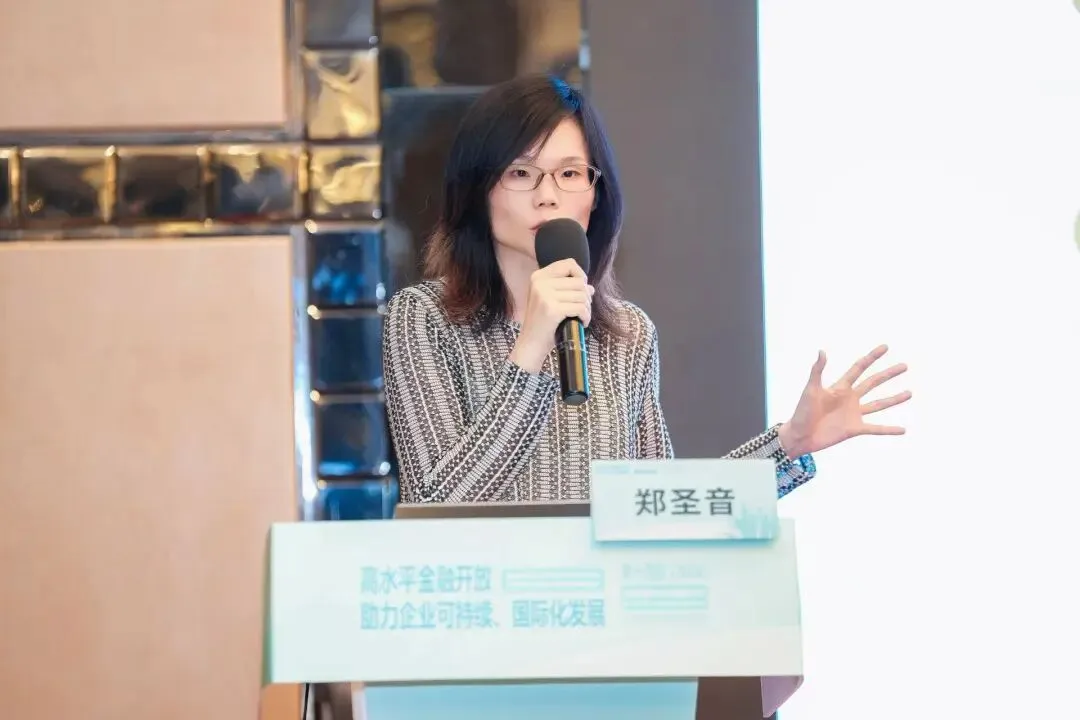
Photo: Ms. Mia Zheng speaking at the symposium
In her talk, "Reshaping the Value of ESG in an Era of Change: Green Finance Driving New Industrial Upgrading and Corporate Globalisation", Ms. Zheng reviewed the key shifts in the logic of ESG value against a backdrop of geopolitical turbulence, an accelerating global energy transition and fast-moving digital technology. She pointed out that amid sweeping change, ESG has long moved beyond being seen as a compliance cost and is becoming a key lever for companies to innovate, grow revenue, strengthen their brands and build long-term competitiveness. Using the environmental, social and governance framework, she set out the three types of real-world risk companies face when operating internationally, as well as three development opportunities: green technology R&D, niche market development and brand credibility. She also explained three advantages of applying ESG: comprehensive assessment, forward-looking strategic guidance, and quantified management of non-financial indicators.
Turning to how green finance supports new industries, Ms. Zheng started from the practical value of high-level financial opening-up, identifying three roles: bringing in cross-border capital, innovating financial products and co-developing international standards. She explained how four mainstream instruments, green credit, green bonds, ESG equity investment and carbon finance, can support the real economy. In terms of industrial impact, green capital can help bring emerging technologies to market, push energy-intensive traditional industries to save energy, and raise productivity through smart manufacturing. As a practical case, Ms. Zheng looked at Asia Symbol, a benchmark company in its industry, and its circular economy results in water recycling and biomass energy. She broke down the debut sustainability-linked syndicated loan (SLSL) for a foreign-invested company in China's pulp and paper industry, explaining the syndicate structure led by the Agricultural Bank of China, the five quantified KPIs covering environmental protection and employment, and the mechanism that adjusts the interest rate up or down. Citing the project's results in saving water, cutting emissions, creating jobs and lowering financing costs, she highlighted the innovative value of this "double debut" for the industry and its relevance as a reference for adapting international green finance rules to the local market.
On the practicalities of global operations, Ms. Zheng said companies need to balance short- and long-term goals: in the short term, cut costs and stay compliant through energy saving, emissions reduction and supply chain risk control; in the long term, build competitive barriers through green R&D and ESG systems. Overseas expansion should follow a localisation approach, build an end-to-end green supply chain and use ESG to steer global sustainable development planning. Closing her talk, Ms. Zheng offered two thoughts on the industry's future: one, improve multi-level green finance markets and standardised disclosure systems and broaden the range of green finance products; two, deepen the integration of fintech and green finance, using big data and blockchain to improve ESG risk control and product delivery.
Going forward, WeCarbon will continue to draw on its expertise in ESG advisory and green finance to help Chinese companies use ESG management to resolve compliance challenges in overseas markets, seize global opportunities and support the green transformation and upgrading of new industries in China.