
On 23 April, the "Forum on Climate Finance and Sustainability Disclosure", one of the core events of Shanghai Climate Week 2025, was held in Hongkou, Shanghai. The forum was co-hosted by the Green Finance Forum of 60 (GF60) and the Shanghai Climate Week Executive Committee, supported by the Hongkou District Development and Reform Commission, organised by the Shanghai Jinsinan Institute of Finance and co-organised by the World Resources Institute (WRI) and Asia Research and Engagement (ARE), with special support from WeCarbon.
This year marks the tenth anniversary of the Paris Agreement, and the global climate governance system has reached a new crossroads. The forum focused on key issues in climate finance, with in-depth discussions on the practice and development of climate finance, the prospects and opportunities for green investment, sustainability disclosure by commercial banks, and the role of capital markets in the green, low-carbon transition. On site, ten institutions jointly released the "Joint Initiative on Climate Finance and Sustainable Development", working together to explore new paths for climate finance and to contribute China's experience and voice to global climate governance.
GF60 Forum on Climate Finance and Sustainability Disclosure
01
Opening Remarks
The forum opened with remarks by Wan Jianhui, Party Secretary and Director of the Hongkou District Development and Reform Commission, Shanghai, and Zou Rong, Co-Chair of the Shanghai Climate Week Executive Committee.
Mr. Wan noted that, as a core area of central Shanghai, Hongkou District is committed to a green, low-carbon development strategy and continues to deepen its green industry base. The district is now home to more than 800 green and low-carbon enterprises, and high-level platforms such as the country's earliest environment and energy exchange and the Green Finance Forum of 60 have been established there. In 2024, Hongkou completed the project initiation for two-thirds of Shanghai's sustainability standard revisions, providing strong support for the standardised development of the industry. In exploring green development, Hongkou, a district specialising in green and low-carbon services under city-district coordination, is building a market system covering all scenarios around the goal of the city's green transformation, spanning greener urban areas, a greener economy and greener lifestyles, backed by a series of supporting policies. He stressed that, positioned as "Shanghai's core hub for green and low-carbon services" and building on the North Bund demonstration zone, Hongkou will deepen innovation in climate finance mechanisms, work with global partners to build a green ecosystem, steadily advance its sustainability goals and strive to set a new benchmark for green urban development.
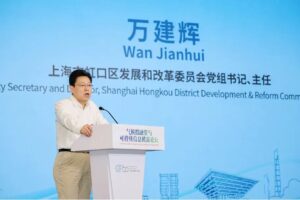
Wan Jianhui, Party Secretary and Director, Hongkou District Development and Reform Commission, Shanghai
Mr. Zou reviewed the work of Shanghai Climate Week over the past year, including bringing together support and partnerships for nearly 100 events, supporting the "Climate Beacon" cross-sector cooperation network, advancing a standards system for manufacturing, and helping an academic concept of climate city parks prepare for its debut at the Venice Biennale. This year, he said, Shanghai Climate Week expects participants from more than 30 countries to join over 70 events during the week. It is also gradually building research cooperation platforms and exploring a resilience standards system rooted in Eastern cultural thinking, offering new solutions from Chinese practice to global climate governance. The "Climate Week 4 Seasons" concept introduced this year will further strengthen the action chain of well-known climate weeks around the world. He described the Green Finance Forum of 60 as a key "global partner" of Shanghai Climate Week and said he looked forward to working with international professional platforms to build an influential green finance brand, establish practical working mechanisms, and promote exchange and practical innovation in global climate and transition governance.
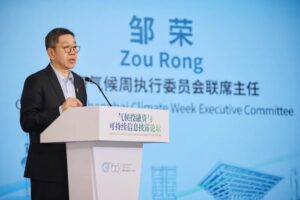
Zou Rong, Co-Chair, Shanghai Climate Week Executive Committee
02
Keynote Speeches
In the keynote session, Ajay Bhushan Pandey, Vice President of the Asian Infrastructure Investment Bank (AIIB); Lu Xuedu, Executive Deputy Director of the Carbon Neutrality Committee of the China Energy Conservation Association and former Lead Climate Change Specialist at the Asian Development Bank (ADB); and Zhang Weili, General Manager of the Strategic Planning Department of the National Green Development Fund (NGDF) delivered speeches.
Mr. Pandey said that climate change is a common challenge for the world and requires united action. Green development is also a core value of the AIIB: since its founding in 2016, the bank has approved more than 300 projects with total investment of USD 60 billion, and it hopes that climate investment will account for more than 50% of its total investment in the future. He stressed that the AIIB fosters an innovation ecosystem through green infrastructure and AI enablement, improves transparency through standardised sustainability disclosure, and brings together government, business and civil society resources to turn climate risks into investment opportunities and reshape the economic paradigm of the future through resilient infrastructure and knowledge sharing.
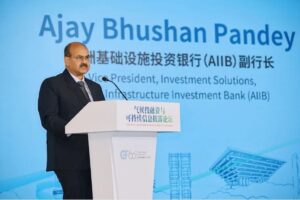
Ajay Bhushan Pandey, Vice President, Asian Infrastructure Investment Bank
Mr. Lu noted that in August 2022, the Ministry of Ecology and Environment and eight other ministries approved 23 regions across China as the initial batch of climate investment and financing pilots. Since then, the pilot regions have carried out extensive work on policy innovation, practice and product innovation, project preparation and institutional capacity building, achieving notable results and many innovations, while still facing a number of problems and challenges. He suggested that climate finance needs to be defined more precisely and climate benefits quantified further, to help identify and support climate finance projects and improve the quality of projects in the pipeline and the returns on climate investment. If sustainability disclosure, an important source of information for investment decisions, were made a mandatory element of the climate finance pilots, it would help raise project financing, get projects off the ground and generate more climate benefits that can be turned into assets. The policies, measures and actions of the relevant departments should also be coordinated to better ensure the success of the pilots.
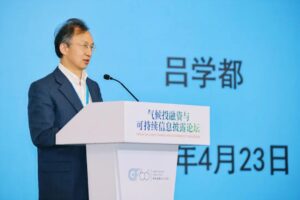
Lu Xuedu, Executive Deputy Director, Carbon Neutrality Committee, China Energy Conservation Association; former Lead Climate Change Specialist, Asian Development Bank
Ms. Zhang said that the National Green Development Fund has so far invested about RMB 26 billion in 66 projects, supporting projects and industries in five areas: environmental protection and pollution control, ecological restoration and greening, energy and resource conservation, green transport, and clean energy. Nearly RMB 17 billion, or 65% of all capital invested, has gone to sustainability-related fields, mobilising more than RMB 100 billion of private capital in total. Drawing on the fund's investment practice, she shared four reflections: (1) tackling climate change requires long-term, stable and large-scale financial support; (2) investors should stay committed to the long term and act as "patient capital", investing in long-horizon and hard-tech projects; (3) investors should respect market rules and focus on real application scenarios so that the value of carbon reductions and carbon premiums can be realised; and (4) international exchange and cooperation on climate change should be strengthened, with full support for Shanghai's sustainability-related green development.
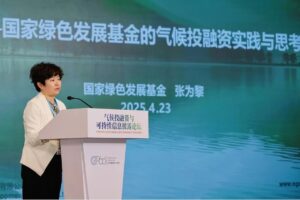
Zhang Weili, General Manager, Strategic Planning Department, National Green Development Fund
03
International Dialogues
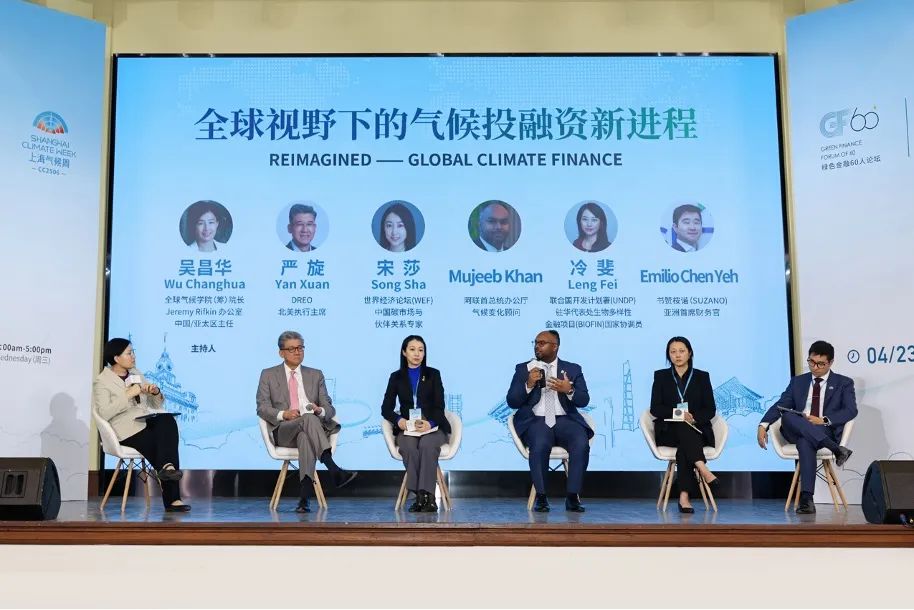
International Dialogue I, themed "New Progress in Climate Finance from a Global Perspective", brought together experts from many fields, including Yan Xuan, Executive Chair of DREO North America; Mujeeb Khan, Climate Change Adviser at the UAE Presidential Court; Leng Fei, National Coordinator of the Biodiversity Finance Initiative (BIOFIN) at the United Nations Development Programme (UNDP) China Office; and Emilio Chen Yeh, CFO Asia of Suzano, for an in-depth discussion of the progress of global climate finance since the signing of the Paris Agreement in 2015 and the challenges ahead.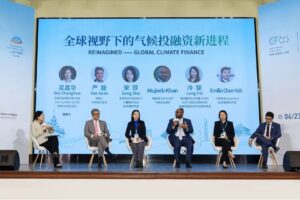
International Dialogue I: New Progress in Climate Finance from a Global Perspective
International Dialogue II, themed "Green Investment: A Sustainable Path to the Future", was moderated by Luan Dong, Head of Climate Finance Research at BloombergNEF. Li Junfeng, Venture Partner at HongShan (formerly Sequoia China) and Standing Director of the China Energy Research Society; Wu Zhu, Chief Investment Officer and Partner of the China-U.S. Green Fund; He Yizhou, Managing Director and Greater China CEO of Australian Capital Investment; and Zhao Jing, Partner at Cathay Capital discussed the shifts and challenges facing green investment amid the green, low-carbon transition, the market potential and opportunities of green equity investment, and international investors' attitudes towards and outlook for Chinese green assets.
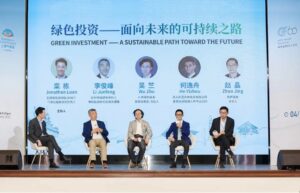
International Dialogue II: Green Investment: A Sustainable Path to the Future
04
Release of the "Joint Initiative on Climate Finance and Sustainable Development"
The forum released the "Joint Initiative on Climate Finance and Sustainable Development". Representatives of ten institutions, including the Green Finance Forum of 60, SPD Bank, Shanghai Rural Commercial Bank, Weihai Bank, ICBC-AXA Life, Industrial Securities, Shanghai Sci-Tech Innovation Fund, HSBC Jintrust Fund and Neuberger Berman Fund, jointly committed to actively take part in climate action, keep improving green financial services, systematically strengthen climate-related risk management, vigorously advance climate-related disclosure, build up talent for climate finance, and deepen international cooperation on climate finance. The initiative is a solemn commitment by all parties to green development and also provides a systematic action plan for green finance practice, aiming to promote the long-term, healthy development of the green finance system through multi-dimensional strategies and innovative mechanisms.
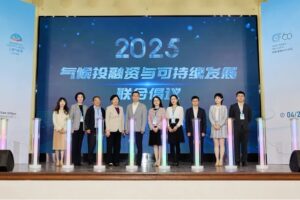
Release of the "Joint Initiative on Climate Finance and Sustainable Development"
Thematic Addresses
The afternoon sessions focused on sustainability disclosure. In the profound changes brought by climate action, sustainability disclosure is a key link between the supply of and demand for climate finance and plays an important role in allocating resources effectively and innovating financial products. Amid today's complex and changing international situation, how can a more efficient and transparent sustainability disclosure standards system be built? And what action should financial institutions, as key players in green investment, take in response?
The afternoon opened with addresses by Liao Shuanghui, Secretary-General of the Green Finance Forum of 60 and Chairman of the Shanghai Jinsinan Institute of Finance, and Qiang Liu, Director of the Climate Change Programme and Deputy Chief Representative for China at the Children's Investment Fund Foundation.
On behalf of the host, Mr. Liao welcomed the guests. He noted that innovative financial instruments and high-quality disclosure are important levers for solving the problems of climate governance. GF60 has long been rooted in climate finance, taking an active part in policy design and providing solid professional support for policy implementation. In recent years, GF60 has published research including "Development and Improvement of the Financial Attributes of Carbon Markets", the "Research Report on Climate Disclosure and Carbon Accounting in the Banking Sector" and the "Quality Evaluation of Climate Disclosure by Listed Companies", providing quantitative assessment standards and recommendations for industry practice. GF60 also works with credit information platforms in several regions, developing practical tools that take climate finance from theory to practice. With an international outlook, GF60 has formed a strategic partnership with the Partnership for Carbon Accounting Financials (PCAF) and become a global capacity-building partner of the International Sustainability Standards Board (ISSB), helping to align and implement international standards. He hoped the forum would deepen consensus on disclosure, accelerate the application of technology, expand ecosystem cooperation and open a new chapter for green finance.
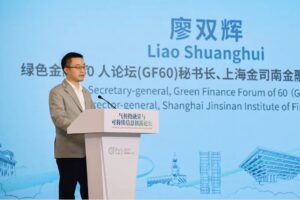
Liao Shuanghui, Secretary-General, Green Finance Forum of 60; Chairman, Shanghai Jinsinan Institute of Finance
Mr. Liu said that, guided by China's Sustainability goals, the low-carbon policy system continues to improve and the green economy has become an important driver of high-quality economic development. Carbon accounting and sustainability disclosure, as key levers for companies to respond to climate change and strengthen their sustainability, have become a strategic focus of the market. He made three recommendations for the next steps in sustainability disclosure: (1) encourage companies and financial institutions to develop and disclose transition plans that set out clearer emission reduction targets and pathways; (2) simplify and align different disclosure standards and requirements to improve consistency and comparability; and (3) strengthen local infrastructure, improve data systems and build more efficient and convenient platforms for sharing climate information, taking sustainability disclosure to a new level.
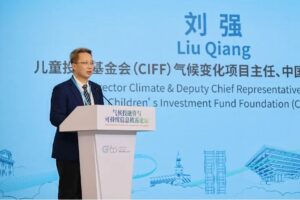
Qiang Liu, Director of the Climate Change Programme and Deputy Chief Representative for China, Children's Investment Fund Foundation (CIFF)
Keynote Speeches
The keynote session featured Zhang Zhengwei, Special Adviser to the ISSB Chair and Director of the ISSB Beijing Office; Fang Li, Chief Representative of the WRI Beijing Representative Office; and Junjie Zhang, Chief Economist of the Green Finance Forum of 60.
Mr. Zhang said that, although the international situation is complex and changing, global warming, the increase in extreme weather events and the deepening scientific consensus remain unchanged. Companies should keep building their sustainability disclosure capabilities and, by measuring and managing sustainability-related risks and opportunities well, strengthen their financial value and core competitiveness. He encouraged companies to prepare early and become "front-runners" in sustainability disclosure, to build ESG into their strategies, and to help related companies along their value chains so that disclosure capabilities improve across the whole chain. Companies also need firm conviction and determination about sustainable development, investing steadily and working with others to become "shapers" of a healthy disclosure ecosystem, take part in and help guide global environmental and climate governance, and gain an early advantage in the wave of sustainable development.
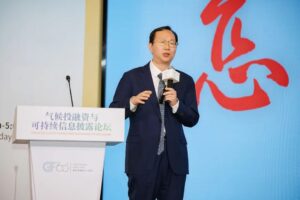
Zhang Zhengwei, Special Adviser to the Chair and Director of the Beijing Office, International Sustainability Standards Board (ISSB)
Dr. Fang delivered a keynote titled "Data as the Foundation, Disclosure as the Bridge: Empowering Sustainable Finance". She said that data and disclosure are the basis for guiding sustainable investment decisions, and high-quality disclosure starts with solid underlying data. On data, the launch of China's national greenhouse gas emission factor database will greatly improve the scientific rigour, accuracy and comparability of carbon emission data; the next step is to strengthen international mutual recognition of the database and its factors. On methodology, the Greenhouse Gas Protocol (GHG Protocol), developed jointly by the World Resources Institute and the World Business Council for Sustainable Development, is the widely recognised international standard for greenhouse gas accounting, and it is now undergoing an update on a scale not seen in nearly 20 years, mainly concerning the Scope 2 and Scope 3 standards for corporate carbon accounting. She called on Chinese companies and financial institutions to take an active part in updating international standards, moving from "adapters" to "co-builders", bringing Chinese experience into international rules and offering the world more methods and lessons from China's exploration and practice.
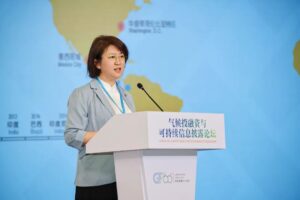
Fang Li, Chief Representative, World Resources Institute (WRI) Beijing Representative Office
On identifying, quantifying and managing climate transition risk at commercial banks, Prof. Junjie Zhang drew on localised models and AI technology to present a four-dimensional analytical framework he has built, covering transition risk identification, financial impact measurement, credit risk assessment and transition risk management. Using VAT invoice data to map companies' production and sales activities and infer their carbon emissions, the approach provides standardised carbon accounting results, minimising the cost for companies of collecting, calculating and reporting emissions information and helping small and micro enterprises overcome carbon accounting challenges. He suggested that commercial banks strengthen their ability to identify, price and disclose transition risk and seize transition finance opportunities; that regulators avoid a one-size-fits-all approach to high-carbon industries and balance emission reduction targets with market fairness; and that companies strengthen sustainability disclosure, focus on financial materiality and turn low-carbon action into a competitive advantage rather than a cost burden.
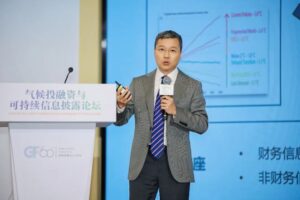
Junjie Zhang, Chief Economist, Green Finance Forum of 60
Thematic Dialogues
Thematic Dialogue I, on "Challenges and Opportunities in Sustainability Disclosure by Commercial Banks", was moderated by Li Xiaozhen, Director of Sustainable Finance at the WRI Beijing Representative Office. Jing Jianguo, Special Expert of the Shanghai Financial Association and Director of the Offshore Finance Institute of the Shanghai Chief Economists Financial Development Center; Yang Guiyuan, General Manager of the Risk Management Department of Shanghai Rural Commercial Bank; Li Wenmei, Managing Director of Sustainable Finance at OCBC; Liu Ning, Head of the Green Finance Department of Weihai Bank; Wu Yanyang, Senior Researcher at CIB Research; and Zhu Ling, Head of China Capital Markets at CDP discussed, each from their own perspective, the current state, problems and future direction of sustainability disclosure by commercial banks. They called for turning disclosure into intrinsic value and momentum that ultimately drives the design and launch of sustainable finance products and channels more capital into green and low-carbon fields.
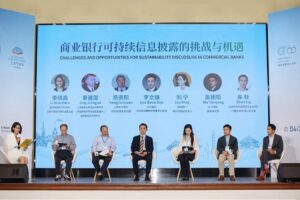
Thematic Dialogue I: Challenges and Opportunities in Sustainability Disclosure by Commercial Banks
Thematic Dialogue II, themed "Capital Markets Supporting the Green, Low-Carbon Transition and Sustainable Investment", was moderated by Wenhong Xie, China General Manager of the Climate Bonds Initiative (CBI). Si Shenghua, Index Product Director of the ChinaBond Pricing Center; Shu Huan, Deputy Head of the Bond Trading Division of the Financial Markets Department at SPD Bank; Feng Jingyu, Deputy General Manager of the Credit Review Department at BOCOM Wealth Management; Fang Xiang, Head of ESG at Neuberger Berman Fund; Xie Xuan, Director of the Green Finance Department at Industrial Securities; and Luo Yan, Professor and doctoral supervisor in the Department of Finance at Fudan University School of Management each shared their views, based on their institutions' positions and practice, on the role of capital markets in supporting the green, low-carbon transition and on current trends and potential opportunities in sustainable investment. The panellists agreed that capital markets, as a major supplier of funds, can use their strong ability to integrate resources to steer capital precisely. As policies on sustainability disclosure continue to take effect, disclosure will become more standardised and transparent, further unlocking the potential of capital markets in green finance.
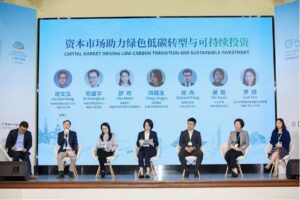
Thematic Dialogue II: Capital Markets Supporting the Green, Low-Carbon Transition and Sustainable Investment
As a special supporter of the Forum on Climate Finance and Sustainability Disclosure, WeCarbon witnessed the fruitful results of the event. Distinguished experts from many fields came together to examine key issues in climate finance and sustainability disclosure, offering valuable ideas and direction for global climate governance and the development of green finance. WeCarbon has long focused on climate technology, and the forum closely matched our commitment to green development. Going forward, WeCarbon will continue to build on its strengths, take an active part in climate technology and green finance practice, and work with all parties to implement the "Joint Initiative on Climate Finance and Sustainable Development", helping to build a more complete green financial services system, contributing to global climate governance and sustainable development, and creating a better green future together.