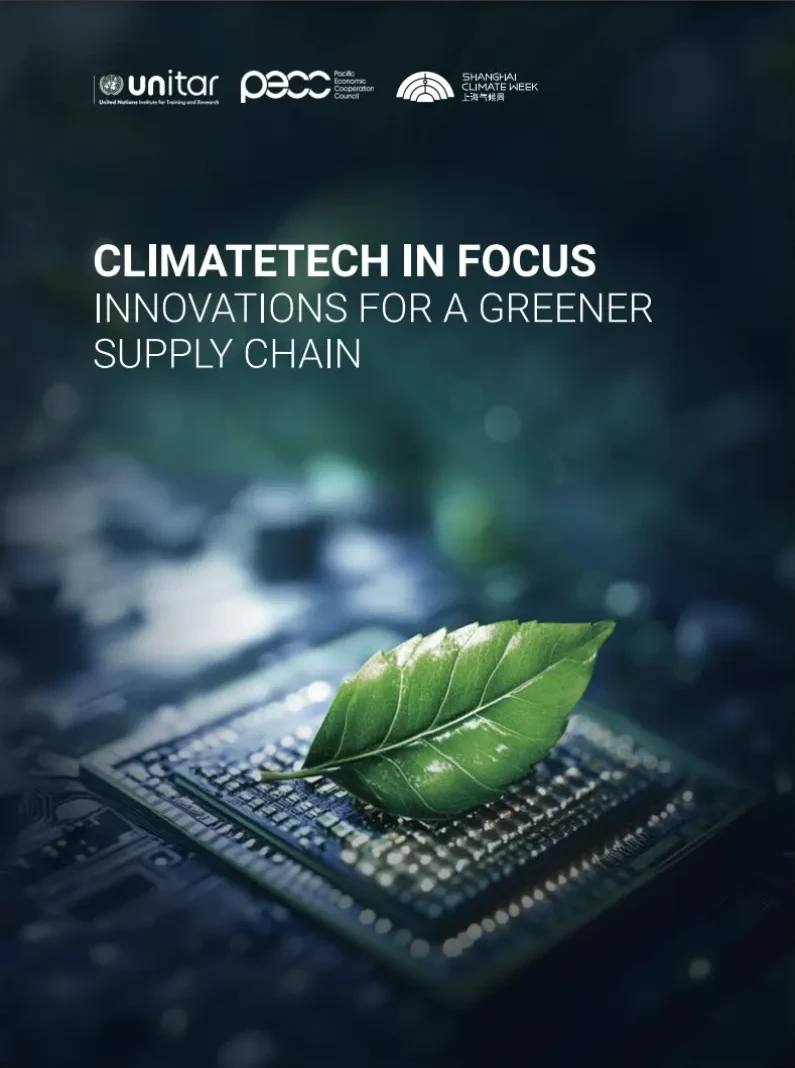
Co-published with UNITAR, PECC and SHCW. We launched the English edition at COP29 in Baku, followed by the Chinese version at the 2025 Shanghai Climate Week.



While technology can enable a zero-carbon economy, it may lead to a green cost premium in many sectors. This means that we will not achieve decarbonization just by a free market. We will need regulation, quantitative targets, carbon pricing, or public policy instruments that level the competition between traditional and cleaner technologies.
Our report ClimateTech In Focus: Innovations For a Greener Supply Chain, published jointly with the Pacific Economic Cooperation Council (PECC) and Shanghai Climate Week, spotlights the pivotal role of ClimateTech in revolutionizing global supply chains towards environmental responsibility and efficiency. This report outlines the essential drivers of climate action—awareness, government goals, and economic incentives—and stresses the urgency of moving beyond compliance to achieve excellence in sustainability. The report advocates for a regulatory framework supported by robust enforcement and education to catalyze tangible climate actions, especially in developing nations balancing environmental and developmental goals.
The report identifies key areas where ClimateTech can lead to significant emission reductions by focusing on traceability, hard-to-abate sectors, and other imminent issues. It also underscores the importance of innovative finance models in bridging the gap between concept and market-ready solutions.
The report calls for a global joint effort involving investors, innovators, educational institutions, and enterprises to harness ClimateTech's full potential and ensure a sustainable and thriving future.
Global technology and innovation serve as beacons of hope in the face of climate change. ClimateTech is not a fleeting trend confined to laboratories; it stands as one of the most promising avenues for humanity to tackle climate change and drive sustainable progress. We are heartened to see many technological innovations moving from labs to factories, industrial zones, markets, communities, and homes, making a lasting, tangible impact on our fight against climate change.
This report, “ClimateTech In Focus: Innovations for a Greener Supply Chain” provides an in-depth perspective of these priorities by diving into the origins of green supply chains, the market landscape of ClimateTech, and the potential for significant impact in key areas. Additionally, it analyses the critical roles that finance, education, and infrastructure play in driving progress and offers actionable recommendations. Through this in-depth study, we call on all stakeholders to collaborate in promoting sustainable practices and implementing actionable initiatives.
ClimateTech In Focus 2024: Innovations for a Greener Supply Chain is the inaugural edition of the ClimateTech In Focus series. It is published by the United Nations Institute for Training and Research (UNITAR), the Pacific Economic Cooperation Council (PECC) and Shanghai Climate Week, with WeCarbon as knowledge partner. The English edition was launched at COP29 in Baku in November 2024, and the Chinese edition at Shanghai Climate Week 2025. This summary of the green supply chain report follows the report's own executive summary.
The report sets out the transformative potential of ClimateTech within global supply chains. It identifies awareness, government goals and economic incentives as the primary forces driving climate action, though the weight of each varies across regions and contexts. Science-based strategies, active stakeholder engagement and synergy are needed to formulate and implement effective government goals. Even so, meeting net-zero targets will take extra effort, which makes affirmative action urgent.
In policymaking, a legal framework is the starting point for achieving sustainability goals; robust enforcement and comprehensive legislative education turn these frameworks into tangible action. Developing countries in particular must focus on the economic implications of climate goals, balancing environmental imperatives with growth and development objectives.
Moving supply chains from lean to green requires prioritizing traceability, addressing hard-to-abate sectors and shifting from compliance to excellence. These objectives depend on retrofitting existing infrastructure and redistributing cost burdens effectively across supply chains. Risk management, operational efficiency and brand differentiation are among the motivators that drive the transition from compliance to excellence.
The report uses technical and adoption readiness metrics to categorize and prioritize the ClimateTech market landscape, keeping the focus on technologies with high potential for impact. It points to four areas for development: big data and AI, the decarbonization of traditional energy systems, green hydrogen and primary chemicals, and the integration of clean energy in logistics. Innovative finance models, such as proof-of-concept funds, are critical to moving innovation from the lab to the factory: they provide the funding needed to turn promising ideas into market-ready solutions and help ClimateTech startups overcome the commercialization challenges they often face.
Effective policy frameworks, strategic financial investment and comprehensive education are indispensable for a sustainable future. Government policy must provide the stability and incentives that encourage green innovation, while finance must extend its reach through innovative tools that support growing ClimateTech enterprises. Education's mission extends beyond traditional boundaries: it includes cultivating future leaders and professionals and providing vocational training that equips people with the skills the green economy needs, building a workforce able to implement and maintain ClimateTech solutions across industries.
Achieving ClimateTech's full potential requires a concerted global effort. Collaboration among governments, investors, innovators, educational institutions and enterprises can set a green economy cycle in motion, making the transition to greener supply chains both feasible and beneficial, toward a resilient and thriving future where sustainability and progress coexist.
The report runs in five parts. Background traces the driving forces from awareness to action and the challenges ClimateTech must resolve on the way from lean to green. ClimateTech Market Landscape assesses technology readiness, the drivers and barriers for future adoption, and the pathway to market readiness from lab to factory. Focus Area Deep-dive covers big data and AI, traditional energy system decarbonization, green hydrogen and primary chemicals, and clean energy in logistics, shipping and aviation. Powering the Progress examines policy and infrastructure, finance and investment, and education and talent. The conclusion, What's Next?, gives recommendations for governments and international organizations, NPOs and education institutions, large enterprises, financial institutions, and SMEs, startups and individuals.
Explores the origins and development of sustainable supply chain concepts and the role of technology in enhancing supply chain sustainability.
Assesses the current state and growth potential of the ClimateTech market, identifying key segments and areas poised for expansion.
Analyzes the progress and potential of four critical ClimateTech areas: AI in supply chain management, traditional energy decarbonization, hard-to-abate manufacturing, and clean energy in logistics.
Examines the enablers of green supply chain transformation, including the roles of finance, education, and infrastructure in fostering innovation and scalability.
Summarizes the report's key findings, emphasizing the need for global collaboration to harness the full potential of ClimateTech and drive sustainable practices forward.
Let us help you create competitive advantages through sustainability, build resilience against climate and supply chain risks, and streamline your path to a sustainable future.